Posts

Showing posts with the label Politics

British Rail Services “Nationalised” in Response to Covid-19

Image
In response to the global pandemic involving the transmission of the Covid-19 (Coronavirus) disease, a number of extraordinary measures are being put in place around the world. In the UK, the Conservative Government has taken a number of steps which, ideologically, go against their principles. Today, the latest in a line of extraordinary measures was taken when the Department for Transport stepped in to, essentially, nationalise the rail industry in the UK on an emergency basis. The developments and details of that extraordinary measure form this post. Rail services, along with other modes of travel like aeroplanes and coaches , were quick to suffer the natural consequences of the worsening of the Covid-19 pandemic. A number of rail operators had already started to reduce their services before the British Prime Minister requested that non-essential travel be avoided, and this was accentuated by a further reduction in services in places like London (where up to 40 underground st...

The Competition and Markets Authority (CMA) Plans for More Regulatory Action post-Brexit, But Will It Happen?

Image
Today’s short post responds to comments made in today’s business press from the Chief Executive of the Competition and Markets Authority (CMA) in the UK, Andrea Coscelli. The sentiment behind Dr Coscelli’s vision of the post-Brexit world for the regulator is that it will be free to pursue certain regulatory actions that it was not entirely free to pursue before, and that now it fully intends on doing so. This may be fair enough, but are there more forces potentially affecting the regulatory scope of British regulators that he is potentially underestimating? Dr Coscelli’s comments in today’s edition of The Financial Times relates to the CMA’s potential regulatory stance towards the big US tech giants once the UK formally moves away from European regulations at the end of the year (once the transitionary period has concluded). Coscelli stated that ‘ the upside [of the UK leaving the EU] is that you take back control – genuinely – of the decisions ’. This sentiment has been conne...

China’s Belt and Road Initiative Moves into a New Phase, but What are the Consequences?

Image
In a previous post, we examined the recent change in environment for credit rating provision in China . It was concluded that this changing of the environment – essentially opening the doors to Western credit rating agencies, fully, for the first time – was based upon forthcoming requirements connected to the ‘Belt and Road Initiative’ being developed by China. We have looked at the Initiative before in a number of posts , but in today’s post we will be assessing some of the latest developments as the Initiative, seemingly, moves into a new phase. It seems that these developments are borne out of necessity, so assessing what these factors mean to the future of the largest development program the world will have seen will be important. Going back to April this year, the tone used by President Xi Jinping was very different to the tone he had used in 2017 to champion the development and growth opportunities that the Initiative would bring. This time the focus was on ensuring that t...

Sajid Javid: The Chancellor from Deutsche Bank (?)

Image
There is a risk in writing and publishing this post before 4pm GMT because as we await news of Britain’s new Prime Minister’s new cabinet, suggestions from the press may have guess wrongly. The strong rumour is that, as Boris Johnson begins to form his new Cabinet, which is likely to include such figures as the disgraced Priti Patel , current Home Secretary is in line to become Britain’s new Chancellor of the Exchequer. The reason for this post is based upon a theme that is currently being played out across the media, in that the past of a number of candidates are being reduced to mere footnotes in favour of a list of compliments regarding their past performances and this is being linked to ideas of what they will do in their new roles. This applies particularly to Sajid Javid who, whilst he is a son of a Pakistani bus driver and represents a ‘ rags-to-riches ’ story, also went to play a vital role in Deutsche Bank’s structured finance gluttonous uptake that both contributed to the...

The Impact of HS2 Continues to Grow

Image
Today’s post focuses on the HS2 rail system that is being developed in the UK, with the aim of linking some its major cities together more than ever before. We have discussed the HS2 project before here in Financial Regulation Matters, with a guest post from Teny Kuti here and an earlier post here . However, whilst the title of the post suggests that the impact of the project continues to ‘grow’, it is this concept of ‘growth’ that is the focus of the post – the environmental damage of the project is continuing to develop at an alarming pace and as recent news suggests, this project will leave a lasting mark on the British environment. This will lead us to question whether there is anything that can outrank money and its creation, as the project continues to demonstrate everything that is negative about that concept. Speaking in October last year, a spokesperson for the HS2 Ltd Company, which is government-owned, stated that ‘ we’re designing a railway that will reshape the eco...

The Conflation of Business and Politics: An Update on the RBS Global Restructuring Group

Image
Unsurprisingly, RBS and its now-infamous ‘Global Restructuring Group’ (GRG) have been covered a number of times here in Financial Regulation Matters (most notably here , here , and here ). We have also analysed the relationship between the regulators, namely the FCA, and the bank itself on account of the massive bail-out the bank received from British taxpayers at the height of the financial crisis. We have called into question the ability, or capacity of regulators to efficiently regulate and punish the bank owing to this ‘special relationship’ and, in today’s post, we will look at the latest twist in the tale that ‘ MPs have referred to as the worst scandal since the financial crash ’. In the previous posts linked above we discussed and analysed how RBS, via its GRG group, failed thousands and thousands of SMEs ( the BBC cite 16,000 ) with a large number of those companies ending up ruined by decisions taken by the GRG unit – the business media state today that ‘ many of the...

The Post-Crisis Debt Cycle

Image
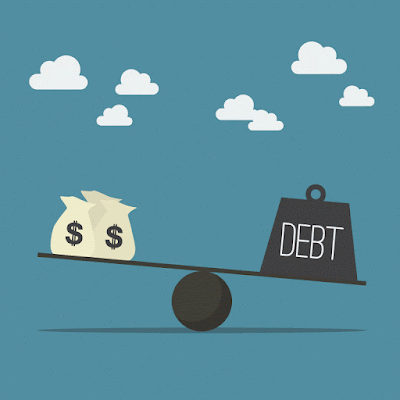
In today’s post, we will look at something which we have covered a number of times here in Financial Regulation Matters , and that is the personal debt arena which continues to increase. After official figures were released recently, we can continue to chart this dangerous phenomena. However, we will examine this issue in relation to a number of connected issues, like consumer spending, to examine what is, in effect, a massively systemic cycle . It was reported recently that, in November alone, more than £400 million was added to the total personal debt owed in the UK alone, which now stands at £72.5 billion . In the UK, the average household debt now stands at £15,385 and this figure is in relation to a number of sources of credit including credit cards, banks, and the auto-sector. In the US, the total household debt stood at just over $13 trillion as of August last year, whilst Chinese debt is continuing to rise. Although we are talking about personal debt in this post, it...

GUEST POST - High Speed Rail 2 and it’s various effects on the Country

Image
Today’s post is a guest post from Teny Kuti, a first-year student in Aston University’s Law School. The post discusses the various effects of the forthcoming HS2 high-speed rail link, as well as some of the potential consequences moving forward. Please follow Teny via Twitter here , and his own blog The Whole Spectrum for an interesting take on a number of different issues, ranging from politics to business. Frequently described as the most substantial rail project ever built in the UK set to open in 2026, High speed rail 2 will form a high-speed link between Birmingham and London, reducing the travel time to 49 minutes. However, the project has never been shy of controversy. Since the HS2 received Government approval in 2012, it has seen strong opposition from those who would lose their homes on the current plans and indeed, HS2 Ltd has claimed that 1,740 buildings would be destroyed by the rail line, with nearly 900 being homes. Now with the recent developments such as the C...

Interserve on the Ropes, or a Model on the Ropes?

Image
Back in August 2017 we looked at the concept of the ‘private finance initiative’, and also the differences between ‘public private partnerships’ and ‘private finance initiatives’, which has also been dissected in the literature . We looked at the issue of Carillion and the aspects that underpinned its high-profile collapse. However, for this post, the question will be whether the recent developments at Interserve, the massive provider of public services in the UK, is part of a general trend or an indication of a fundamental flaw within the model that is being adopted currently. Interserve began as London and Tilbury Lighterage Company Limited in the late 1800s, and through a number of phases of expansion over the century and more that followed, the company was renamed Interserve Plc in 2001. The company has a global reach, but for this post our focus will be on its role within the UK, where its function is particularly vital. According to Interserve itself, it has reported ...

The Office for Students and the Difference between Theory and Reality

Image
We have looked at issues within the Higher Education sector here in Financial Regulation Matters before, mostly in relation to student finances , student accommodation , and also sector-related pensions . However, after some recent developments it is important to take a look at Universities as institutions and, crucially, the position that regulators are finding themselves in, despite any ideological claims as to their operating mandate. As the story develops that, recently, a British University was essentially ‘bailed out’ by the Government, it will be of interest to examine the regulatory reality that the recently-formed Office for Students (OfS) has found itself being exposed to. It was reported towards the end of this week that ‘ a UK university had to be given an emergency loan of almost £1m by the higher education watchdog to stay afloat this autumn ’. The BBC continued by stating that the OfS provided the money when the university faced the prospect of running out of ca...

Post-Brexit Credit Rating Agency Regulation Decided: The Correct Call?

Image
In 2017, this author produced an article that examined the potential regulatory framework that exists in the UK where Credit Rating Agencies are concerned ( later published in 2018 ). We spoke about this issue here in Financial Regulation Matters , where we discussed how there may be a need to incorporate sole regulatory responsibility within one of the regulatory bodies should the UK be unable to come to a ‘deal’ with their EU partners. As part of the EU (Withdrawal) Act, the Government has recently come to a decision regarding which body would be responsible for regulating the CRAs in the wake of a no-deal Brexit, and it confirms the findings of the article. However, it is worth revisiting this developing story to examine what the consequences of such a decision may be. It has been decided, as the original article produced by this author predicted, that the Financial Conduct Authority would be the regulatory body charged with supervising the credit rating industry , should th...