Posts

BP and its Cut to its CEO’s Remunerative Package: Shareholders Begin to Rally, But is it Enough?

Image
In this post, the focus will be on a subject that has been covered previously in Financial Regulation Matters , and that is shareholder activism. It was announced yesterday that BP, the massive Oil and Gas Company, will be cutting its CEO Bob Dudley’s pay package by 40%, to $11.4 million, in response to a revolt by its shareholders . This news represents the realisation of the understanding that was discussed in a previous post that shareholders are becoming more active in determining the direction of their companies, by way of controlling the incentives of their managers. The focus of this post will be on this particular example of shareholder activism, and also the wider effects that this activism may bring. Last year, it was reported that BP would axe up to 7000 jobs after reporting a loss of £4.5 billion , which was the worst in its history. This news was accompanied by the strategy to divest up to $8 billion of its assets over the next two years (so, up until 2018), which ...

The Serious Fraud Office: An Emerging Contender for the Position of Spearhead in the U.K.’s Regulatory Framework

Image
Today’s post looks at the recent headlines garnered by the (relatively) massive fines being given to serious corporate players by the Serious Fraud Office (SFO) in the U.K. This marks a drastic change in approach, as we shall see, and that may be down to the adoption of an American creation known as a ‘Deferred Prosecution Agreement’ (hereafter DPA), which has already been discussed in Financial Regulation Matters . The focus of the post is to show how the SFO is becoming a genuinely powerful and influential regulator for the financial sector and, ultimately, that it must be supported in its endeavours, because of its capabilities to reduce transgressions via the only (unfortunately) palatable form of correction. The SFO has been in the business headlines recently because of a number of high-profile agreements that have been reached under the possibilities afforded by the adoption of the DPA. A DPA became a tool for the SFO in the U.K. in 2014, and was introduced to the arsenal ...

Karen Millen Declared Bankrupt: The Importance of Financial Education

Image
Today’s post aims to use the story that broke recently, that designer Karen Millen has been declared bankrupt after failing to pay a £6 million tax bill , to show that the recent calls by the Financial Exclusion Committee – to promote financial education earlier, and much more strenuously, as discussed in Financial Regulation Matters recently - is of paramount importance. Karen Millen, who as we shall discuss came from the bottom of society to become a household name and would go on to be recognised for her services to fashion, is now, arguably, bankrupt because of the iniquities that exist within the financial arena – in this post, the aim will be to discuss this, and show how an extensive coverage of this concerted effort to educate children on financial matters would, potentially, see an end to instances where those who have talent are being destroyed by those who understand the parameters of a system that naïve participants do not even recognise they are subjected to. Kare...

Shareholders Attempt to Intervene in Tesco’s Business Plan: A Welcome Change of Mentality

Image
In the second post today, the focus will be on the news recently that two major shareholders in Tesco, the massive retail company that engages in multiple avenues of business, have sought to publicly express their opposition to the company’s plans to purchase Booker , a wholesale grocery firm, for a reported £3.7 billion. Whilst there are more elements to this story which need to be discussed, the sentiment that is emanating from this news, that shareholders are taking the long-term into account and not succumbing to the destructive narrative of growth at any cost is the most important way forward, is a very welcome sentiment indeed. Therefore, this post will assess these details, and also the importance of this sentiment being repeated in other arenas. The attempted merger with Booker, which was originally made public in January, was billed as a move which would bring benefits to customers, retailers, and ultimately deliver ‘ significant shareholder value ’. However, the deal...

The Bank of England’s ‘Exploratory’ Stress Test: An Important Precaution

Image
Today’s short post is concerned with the news yesterday that the Bank of England is preparing to put the seven largest banks in the U.K. through an additional stress test , in addition to the resilience test that is conducted annually. The new test, which will examine the bank’s susceptibility to a number of additional aspects, including persistently low rates and higher costs, will run every two years and represents the central bank’s understanding that the volatile environment that we currently inhabit needs to be reflected in the stress tests. So, this post will focus on this new ‘exploratory’ test and assess whether it goes far enough, and whether there are any shortcomings which need to be addressed. The Bank of England has created this additional test so that it may better understand the larger financial environment if the banks in its jurisdiction, as a whole, succumb to the same pressures. The tests, which are based upon 7-year projections , are intended to incorporate g...

The Financial Exclusion Committee: A Necessary Endeavour in a New World

Image
This post is concerned with the recent publication from the ‘Financial Exclusion Committee’, a committee that was set up by the House of Lords to ‘ consider financial exclusion and access to mainstream services ’. The report has created headlines that allude to the poorest in Britain being excluding from banking services, and ultimately being turned towards ‘ high-cost credit ’ and ‘ rent-to-own ’ products, However, there are a number of aspects, some of which are particularly vital for society, which emanate from this report and are worth considering. Ultimately, the report suggests a number of reforms and, although advisory in nature, strikes the right tone in terms of what is required to protect the vulnerable in society as we rocket towards a new phase. The report tackles a number of issues in terms of what is being labelled ‘financial exclusion’. The first aspects that we will look at revolve around the role of the banks within society. The first recommendation that may hav...

Is Dublin Ready and Able to Take Advantage of a ‘Hard-Brexit’?

Image
Today’s post looks at the jostling for position currently taking place within Europe in anticipation of the U.K.’s and the E.U.’s negotiations over the U.K.’s secession deteriorating into what has been termed as a ‘hard-Brexit’ i.e. an almost total separation from the Union and the benefits that come with it. We have already discussed this jostling in Financial Regulation Matters through the lens of a battle between Paris and Frankfurt , but Dublin is emerging as a very credible alternative to those aspiring financial centres. However, there are consequences that come with being the host of such vast but socially-dangerous institutions, and Ireland’s recent history means that it is important to ask whether Ireland should be making itself as open as possible to these organisations. The debate about the jostling for position between Paris and Frankfurt is well covered in the financial press. Also, another issue that has been raised in the press is that the propagation of jobs fr...

Chinese Financial Regulation: The Need for a Single Regulator to Guard Against ‘Financial Crocodiles’ and ‘Poisonous Demons’

Image
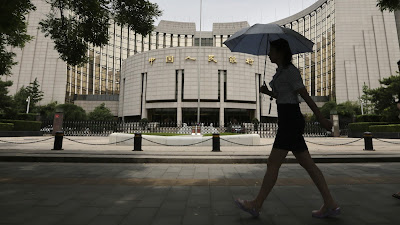
This short post looks to understand the current financial regulatory environment within China, because there is a growing debate as to whether the decentralised and fragmented framework that currently exists is capable of protecting the world’s second-largest, yet arguably fragile economy. The overriding call is to create a ‘super-regulator’ who would oversee all the major elements of the Chinese economy; this is something worth considering, but the recent calls for the People’s Bank of China (PBOC) to take the lead may not be as optimal as it seems. This post, therefore, analyses the problems facing the Chinese economy, and why it has them, and ultimately suggests that a centralised financial regulator would be the best option, but that there must be conditions attached to make it effective. Currently, within China, the PBOC has a broad remit over the macro elements of the Chinese economy, but the detailed elements of overseeing aspects such as banking, securities, and insura...

Credit Suisse and its Insistence on Bucking the Executive Pay Trend

Image
This very short post aims to take a brief look at the recent news that Credit Suisse, the large banking entity that has a substantial presence in a number of key markets, have recently increased the amount that it will pay in bonuses, increasing its bonus pool by 6% which is represented by a total figure of £2.5 billion . However, for a firm carrying the negative reputation that Credit Suisse is currently carrying, this seems to be an exorbitant increase at a time when its competitors, who are similarly experiencing incredible amounts of negative publicity, have cut their bonus pools significantly – Deutsche Bank cut its 2016 bonus pool by almost 80% . This move by Credit Suisse represents either one of two things; either it shows the need to retain talent by way of increasing the remunerative package being offered, or it shows the disregard to those affected by Credit Suisse’s poor practices. Once again, the notion of ‘perception’ proves to be central here. Credit Suisse, like ...

HSBC and its Consistent Connection to Money Laundering

Image
Yesterday, the Guardian Newspaper in the U.K. broke the story that a gigantic money-laundering operation, dubbed the ‘ Global Laundromat ’ had included a number of leading banks, amongst which was HSBC. This short post will look at how the mentioning of money laundering is becoming almost analogous with the mentioning of HSBC and that, ultimately, the bank is in danger of facing the greatest threat that a bank can face - an irreversible loss of its reputation. HSBC has a long association with facilitating the illegal flow of money, either from illegal sources or via tax evasion. In 2010, the bank was ordered by the Federal Reserve to improve its money laundering procedures . Then, as was discussed in a previous post in Financial Regulation Matters , the bank was fined $1.9 billion in 2012 by U.S. authorities for ‘exposing the U.S. financial system to money laundering’. This was predicated upon a damning investigation led by Senator Levin of the U.S. Senate, that systematical...

Blog Updates: Lloyds Sets up HBOS Review for Victims of Scourfield’s Fraud; A New Wave of Warnings for Executive Pay in Advance of AGM Season; and Barclays Threatens Theresa May Because of Brexit

Image
Today’s post provides for updates on posts from last month in Financial Regulation Matters , as recent news has suggested that there are particularly important developments looming. Firstly, the post will look at the developments being undertaken by Lloyds in response to the fraud undertaken by Lynden Scourfield, via Halifax Bank of Scotland (HBOS). Then, the post will provide updates on the new wave of warnings being aimed at executives in receipt of large pay packages. Lastly, the post will provide a passing comment on the recent, undeniably brash warnings given by the Chairman of Barclays to Theresa May. Lloyds’ Griggs Review On the 6 th February, the case of six financiers being jailed for almost fifty years was the target of a post in Financial Regulation Matters . The financiers, led by the head of the Corporate Division in HBOS Lynden Scourfield, conspired against the owners of small and medium sized enterprises (SME) – the scheme was to funnel the business into the...